Situational nightmares vs. replicative trauma nightmares

I’ve written many blog postings about nightmares over the years (see a listing at the end of this article) and dedicated sections on both my website and a section in the book, Morpheus Speaks: The Encyclopedia of Dream Interpreting.

But I want to draw a distinction between nightmares that are born of the need for our health and well-being and those that are reenactments of trauma e.g., the kind many people identified as suffering from PTSD. How you treat them is significantly different.

Nightmares come from the unconscious psyche trying to gain your conscious attention usually because there are events and stressors going on around you or at a subconscious level that you are not paying attention to but can affect you negatively if you don’t act on them. Frequently this kind of nightmare will show up repeatedly until you finally act or until the danger has passed. This type of nightmare can often, though not always, be adequately dealt with by going back into the nightmare while not fully awake or enlivening them after one has awakened, gleaning their meaning and hidden message(s) and or changing the narrative and bringing them to a more satisfactory conclusion. This can be done either on one’s own by looking for the positive in the dream or looking for the environmental triggers that may bring them about. Often this can be done with a friend or even in a dream group.

Being continuously bathed in negative images from TV shows and the news media can often be triggers for recurring nightmares. Limiting one’s exposure to these triggers can prove cathartic and helpful in lessoning or eradicating most recurring nightmare sequences or reduce the number of nightmares over time.

However, those who have suffered extreme trauma e.g., having been physically attacked, raped, intimate partner violence, repeated psychological or physical abuse, experience of extreme events of death, near death, or causing the death of another, or extreme uncontrollable and recurring chaos can sometimes relive these traumas over and over again ad infinitum and require medical and therapeutic help to deal with reoccurring and unrelenting nightmares. These relived or replicative moments of trauma through almost nightly nightmare dreams are symptomatic of those suffering from Post-Traumatic Stress and require professional help in dealing with them. To continually relive them can become physically and psycho-emotionally debilitating and fall into the category of a disorder.

Website:

http://thedreamingwizard.com/nightmares_304.html

Blog postings:

Dreams and hypnosis

Not too long ago someone asked about the relationship between dreams and hypnosis.

Did you know that dreaming and hypnosis have a lot in common? Both tap into what the subconscious is observing and has stored. Both place the conscious mind in a state that allows for access to the unconscious. Neurologically these frequency wave states are called alpha and theta (8-13 Hz and 4-7 Hz respectively. A Hz being a “Hertz,” which is the name for a cycle per second).

Sometimes hypnosis can help you to recall a forgotten dream, or it can be used to go back into a favorite dream so that you can finish it up (don’t you hate it when you’re in a great dream and you wake up in the middle of it?).

Hypnosis can also be used to generate dreams (dream incubation) or be used in the technique called “Active Imagining” when you take a dream theme and imagine it evolving beyond the reality of the actual dream. For example, one can take an image or a person from the dream and imagine it into the room during a meditation and then interact with it by asking questions of it to get greater insight as to its meaning. This is sort of like Gestalt therapy when the client imagines a theme or an outcome or places themselves in another’s shoes by acting it out.

There are several states of consciousness with the mind crossing in an out of all three–Beta, Alpha, Theta and even a fourth, Delta, though this last one would be very momentary for this is the state of deep sleep. Each state has its own breadth and depth of consciousness and unconsciousness. Thoughts (what we laughingly call consciousness) is quite broad, but has very little depth, whereas the dream state isn’t very broad in that it is more focused but is very deep and then there’s hypnosis which has a lot of focused consciousness and a much larger depth of unconsciousness.

To incubate a dream, or to set the stage for what is known as a “Lucid Dream” (one where you are aware that you are dreaming when in the dream, which allows you to orchestrate it), suggestions are placed during a hypnosis session. These sessions can use cultural ideas, values, or behavior patterns (called memes) in the form of suggestions that are “planted” into the unconscious and which can be brought to consciousness by attaching a cue to them in the form of a word, phrase, sound, or visual stimulus that when expressed will activate the meme. For example, “When you see your hand in the dream you will become lucid.” These are good for the short term, so are effective in dream incubation and recall. 

The mind is a fascinating and often mysterious thing!

Nightmares, Night Terrors, and fear in dreams


nightmare.jpg

By thinking about what each dream element means to you or reminds you of, by looking for parallels between these associations and what is happening in your waking life, and by being patient and persistent, you can learn to understand your dreams.

Nightmares are very common among children and fairly common among adults. Stress, traumatic experiences, emotional difficulties, drugs, medication, or illness often cause nightmares. However, some people have frequent nightmares that seem unrelated to their waking lives. Recent studies suggest that these people tend to be more open, sensitive, trusting, and emotional than average.

Recurrent dreams or nightmares, that can continue for years, may be treated as any other dream. That is, one may look for parallels between the dream and the thoughts, feelings, behavior, and motives of the dreamer. Understanding the meaning of the recurrent dream sometimes can help the dreamer resolve an issue that he or she has been struggling with for years.

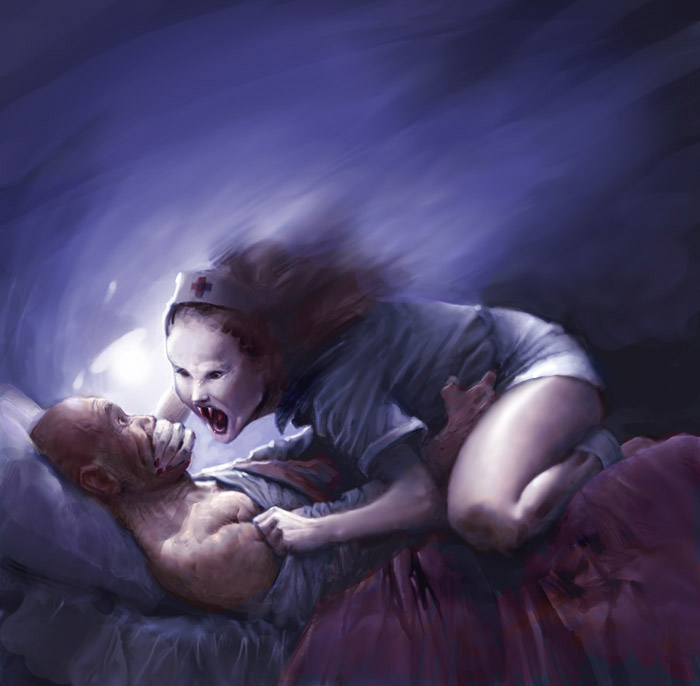
Some people experience extreme feelings of fear in their sleep. As opposed to nightmares, which happen during REM sleep, night terrors or ‘incubus attacks’ occur during stage four of sleep. Unlike nightmares, which we often remember as movie-like dreams, those who suffer from night terrors can rarely explain what they were dreaming of, other than that they experienced an extreme sense of fear.

However, when they do remember, spiders, snakes, animals, people, paralysis, or an evil presence in the room are often featured.

Some sufferers continue to hallucinate when they wake, which can cause some to become violent, either as a response to their dreams, or in an attempt to run away. The cause of night terrors is thought to be increased brain activity, or a chemical reaction that makes the brain ‘misfire’. For many, medical treatment is necessary to help them cope.

Note that in children any night terrors tend to dissipate over time with most children no longer experiencing by the time they reach their preteens.

For more on nightmares you might want to consult the following link:

http://thedreamingwizard.com/nightmares_304.html

Another link that looks at nightmares is a March 15, 2017 posting on this blog:

https://darkknightofthesoulblog.wordpress.com/2017/03/15/nightmares/

If interested in exploring this further go to this blog’s “search” box (to be found at the bottom of any posting page after clicking on the title of any posting) and type in “Nightmares” and several posts dealing with dark dreams will come up.