There is an uncontrolled and uncontrollable background world from which we are all born and out of which we motivate our lives. It is only through self-reflection, the art of transcending our conscious selves that we can discover a psychological resilience the likes of which the vast majority of people have never known or even knew was possible.
This is the art of reflecting on our experiences instead of being caught up in them. To do this one needs to gain some distance from them. For example, one can experience being depressed and become so wrapped up in the experience that it’s like being caught in a never-ending maze where you seem to wander aimlessly forever.
But transforming the experience from one of “being” depressed to the depression as being a signal that your approach to life has been outgrown and that a new approach needs to be developed can take you outside the experience and allow for a new perspective and change.
In short, by being your symptoms you can become lost, but by using the symptoms as signals of the psyche’s attempt to heal itself you can transcend, step out of, the maze. As with everything else the symptoms aren’t what’s causing the imbalance e.g. depression, they are only indicators that an imbalance exists. Too often we get caught up in our ego needs and forget that we are actually creatures of a much greater background world.
When we act as though we are our symptoms (fear, anxiety, depression, anger, powerlessness, etc.) we automatically try to avoid or cast out the demon. In other words, we try to reject rather than go into relationship with the symptom.
When we reject our feelings, our thoughts, or our unwanted memories we send the pains they cause into the dark cellars of our unconscious mind where they can fester and source all kinds of mischief. The art of reflection is the first step into dealing with our imbalances directly and one of the best ways of reflecting on our inner self is through the analysis of dreams. It is through our dreams that we can connect with that background world from which we all come.
In the dream it is the soul that reflects on itself while the ego sleeps rather than the daytime reflections of the ego upon itself that rarely produce any useful insight. Learning to see reality through your dreams can be a transforming experience.
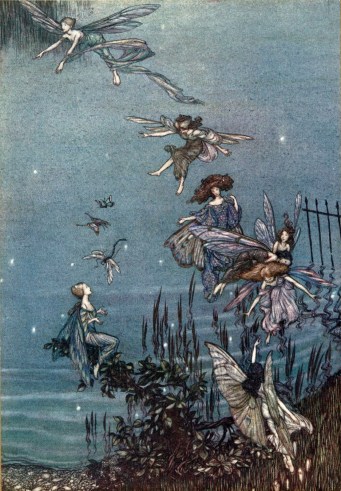
Arthur Rackham ~ The Fairies of the Serpentine ~ 1906
“Come Fairies, take me out of this dull world, for I would ride with you upon the wind and dance upon the mountains like a flame!”
–William Butler Yeats
On my meditation walks I am often moved by the life going on about me– boys and girls with hockey sticks and skates battling street pucks at dusk, flocks of screeching Crows nesting in trees, the smile of the crescent moon with the wink of Venus below her, on a warm night crickets and barking dogs, on a cold and crisp one nothing but silence and the sound of my own footsteps. Sometimes a breeze whips through the branches and rustles the leaves and I hear the raucous laughter of a party just seen through the picture window of the house across the street.
And the world seems right.
But on other nights my mind is disturbed with its thoughts and whirls like a demented vortex and I hear nothing but my own voice. It’s a boring voice droning on and on about inane this’s and that’s and burying the peace of the night in rubble.
And nothing in the world seems right.
I long for the magic I’ve so often felt on so many earlier sojourns through the dark, but tonight it’s not to be. This is when I cry out to the dark denizens of the netherworld, “Come oh magic creatures of the imaginal and entertain me. Bring to me your mystery, your awe, your wonder, and your hidden treasure– make it better than it is.”
That night’s dreams brought me headstones and skulls, darkness and gray empty fields– a reflection of the mood carried back from the earlier journey. And then I ran across the poem by Yeats and I thought, ‘It’s not the fairies of the land he is calling to, but those of the inner soul who are entreated to crawl out from the rubbish and dance with me once more’.
“I am going to teach you the first step to power,” don Juan said, beginning his instruction in the art of dreaming. “I am going to teach you how to set up dreaming.”
“What does it mean to set up dreaming?”
“To set up dreaming means to have a precise and practical command over the general situation of a dream. For example, you may dream that you are in your classroom. To set up dreaming means that you do not let the dream slip into something else. You do not jump from the classroom to the mountains, for instance. In other words, you control the view of the classroom, and do not let it go until you want to.”
“But is it possible to do that?”
“Of course it is possible. This control is no different from the control we have over any situation in our daily lives. Sorcerers are used to it, and get it every time they want or need to. In order to get used to it yourself, you must start by doing something very simple. Tonight, in your dreams, you must look at your hands.”
–Don Juan to Carlos Castaneda in “The Art of Dreaming”
Of course the shaman (or sorcerer) Don Juan was alluding to the phenomenon of lucid dreaming i.e. becoming conscious within a dream and being aware that you’re still dreaming. In this state one can actually direct the events and outcome of the dream.
But he could just as easily have been talking about what you and I call the ‘waking state’ dream, the every day activity that we call reality.
Most Psychologists believe that we all project our thought images (ideas, desires, expectations, judgments, feelings, fears, etc.) onto the events and images of the world around us– there’s a world of objects and events and then there’s what we make of those, what meaning we give them and how we then respond to that meaning.
Basically we make up our own reality, it’s true! Research on the accuracy of witnesses has shown time and again that what was seen is often not what was actually there i.e. the mood, attention, and past experiences of the witness affects what is reported.
Even the choice of words to describe an event is affected by the witness’ past experience with those words. Ones experience about another persons ethnicity, age, size and physical features all contribute to the reality seen and the reality reported.
Unless properly trained in the art and science of observation we create our own reality and even then such things as unconscious motivations and undetected prejudices will affect the reality created.
Dreams are like this as well. They are the images, feelings, and symbols of our unconscious mind playing out in our unconscious sleep state and the unconscious attributes of ourselves that creates a reality within the dream. To interpret them in the waking state requires a conscious understanding of ones inner symbolism and how that is projected onto the outward reality. This is not an easy task and very often requires the aid of observers outside the mind.
Dreams are all about symbolism, the meaning projected onto each image, each event, and each person, or animal in the dream. This is also the reality of our waking state in that we almost never see reality for what it is.
In short, you and I “dream” our reality into existence. We may actually always be dreaming.
And just as with the lucid dream within the sleeping dream one can create ones meaning and outcomes beyond those that the waking dream seems to be presenting. For example, if you don’t like the current events of your waking dream life, then change them, create another reality, dream another response set to the reality about you. In other words, become lucid within your waking dream– start noticing that you are indeed asleep, then wake up!
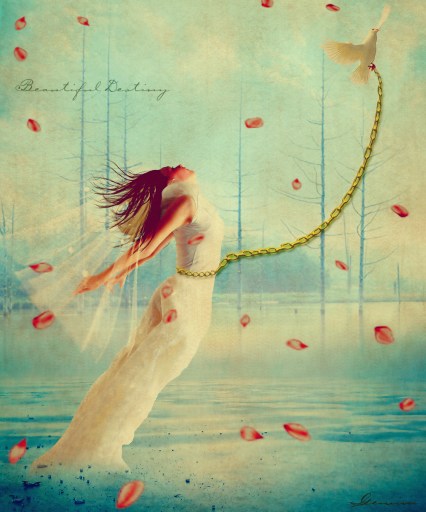
Carl Jung imagined that as a general rule the soul comes in two forms the Anima and the Animus. These are archetypal personifications of the soul in each of us. I use a feminine image above because I think of a man’s soul as being associated with the feminine (Anima) in nature in both its positive and negative aspects. The dove for me represents that which is freeing my soul from the captivity (chain) of the ego-body.
Not too long ago I read an article in the New York Times. It was a story about the museums of death found in many places around the world. I was surprised by the title for I thought all museums were about death aka Natural History museums with all its carefully displayed dead animals, Art museums where most of the painters have been dead for such a long time, The National Funeral museum in Houston, Tex., antique auctions museums where you can find really old furniture from the houses of dead people, well you get the idea.
And what’s the fascination with cemeteries and skulls and horror stories?
I think that we dwell in awe and fear at the world’s greatest mystery, death. It’s that part of life that terrifies most of us because it portends something we can know nothing about, non-life, specifically our own. What is non-life? We know it’s the opposite of what we have now, but what is the opposite of life really? And why do we even ask the question? Fear? Fear of the unknown, fear of what is dark to us? Our unconscious mind is dark to us but as long as we are alive we have potential access even though we’d rather not, but death? Now there’s a darkness and unknown we can’t even begin to fathom. It’s a bottomless abyss that goes on forever.
For some it’s not death that is feared but the process of getting there because it can be so frighteningly painful and mostly uncomfortable or so it looks. We humans will enter into almost anything if we truly believe there’s a pot of gold at the end of it– something better than what we have though we’re never satisfied with what we have. But not to know? Too scary.
The promise of no pain and eternal peacefulness seems a pretty good draw for letting go of life so as to enter some kind of heaven, but the “Great Decider” determines whether we wind up there or in the burning cauldron’s of hell, or so we’ve been told, though I’m pretty sure those stories come from the same type of folk that wrote the stories for the Brothers Grimm and for the same reason, to keep the children in line, whether they be little children or adult children. This reflects the belief that left to their own devices people won’t do the right thing. That is of course a pretty cynical view of humanity usually portrayed by the “fearful ones” who don’t know who they really are and by extension who we are. In the United States we call them Republicans or the Alt-right.
Some folks have solace in the belief that they, body and all, pass into another realm. But the ego part of us is of the flesh, that 3lb squishy thing inside our head that some of us occasionally think with and that decays and shrivels and turns to dust– we like with everything else in life can’t take it with us. So what is it that goes on to wherever we imagine consciousness continues on to?
“The soul! The soul goes on” cry still others. But what is that? Have you ever seen it? How often have you been aware of it? Do you actually identify with it? How many of us truly know of that invisible, ephemeral ghost in the machine that we imagine to be us, after all aren’t we the thinking, feeling, frightened, pain wracked, opinionated, memory-filled, squealing thing with a name and social security number?
So what is the soul? Is it a living thing? Well if it is living within the body wouldn’t it be subject to the same decaying effects after death? Ahh, so it’s not alive, it’s, what, a spirit? What’s that? And why does it need us as a host to visit the world? And if it loses its host where is it, what does it experience then? Is it conscious? Was it our consciousness all along only we became duped by the not so long lasting ego that convinced us that we were actually the ego?
Recent research has shown that even after a person has been pronounced brain dead, usually a no-turning-back step beyond clinical death when the heart stops, that “consciousness” may in some cases continue beyond the functioning body1. This is known as an OBE or Out of Body Experience. What that consciousness is however, that appears to be separate from the brain has scientists stumped.
This soul thing probably has no fear of death because death isn’t part of its life but the ego is a jealous thing and envies and fears the soul because of its non-death. It dreams of being like its opposite and creates a myth of everlasting life. There is everlasting life, but probably not like the life we currently experience, but the ego doesn’t want to hear that, so let’s just keep that between us.
Still others see the soul as a transmitter of the spirit into the receiver of the brain that then allows it to be manifest in the world making us sort of like a TV with arms and legs.
“Tell me not, in mournful numbers,
Life is but an empty dream!
For the soul is dead that slumbers,
And things are not what they seem.
Life is real! Life is earnest!
And the grave is not its goal;
Dust thou art, to dust returnest,
Was not spoken of the soul.”
The Psalm of Life
by– Henry Wadsworth Longfellow
I go into greater depth with the exploration of death in the Chapter from the “Dragon’s Treasure”titled Death, Yours, Mine, Ours (pg. 168).
____________________________
1 Life after death? Largest-ever study provides evidence that ‘out of body’ and ‘near-death’ experiences may be real, independent.co.uk/news/science/life, 7 Oct. 2014.
Q: Do you think there is something like a magical person, Bob? Are some people really magical or is it an illusion we create?
A: There are mystics, who seem moved by the spirit of something ineffable and there are those who are so integrated with the world around them that they seem to make things happen. There are also those who have the unexplainable* show up in their lives at a greater frequency than normal. There are those people who seem to exude magic as though there is some unseen source of energy about them as well. There are yogis, gurus, shaman and just ordinary people who can do phenomenal and extra-ordinary things. I don’t think there are Harry Potter wizards and witches with wands and broom sticks, but there are those who seem to wield a form of magic.
One of my favorite writers of this kind of magic is Carlos Castaneda who wrote about a Yaqui shaman named Don Juan who I believed after three books was a real magician. Though the character was fictional, Castaneda wrote from what he knew and what he knew was truly magical and extra-ordinary. I have tried a number of the lessons taught in these books (they are novels not self-development books) and have found them useful both in my practice and in everyday life.
And this would be my definition of “magical”, the ability to produce and perform the extra-ordinary. Some people are very adept at that. Some are able to see things that the rest of us do not and are able to use what they see in extraordinary ways. Some have phenomenal talents that they are able to boggle the mind with. As you know I believe that within all of us there is a magic waiting to be unleashed. Some are closer to it than others, meaning they have fewer obstacles to its expression. What I write about is how to deal with and overcome some of the obstacles.
Keeping in mind my definitions and caveats, in my nonprofessional opinion my answer to your question is “yes” there are probably magical people e.g. people who wield magic.
*I use this word whenever I come up against a phenomenon that appears real, but is without any scientific corroboration, or explanation.
When we fall asleep we enter a world of the unconscious where the personality, the ego-self, surrenders itself and the self-conscious barriers to reality dissolve into nothing. Suddenly we can walk through walls, traverse time in all directions and jump from one place to another without any external transportation.
Time and space seem irrelevant to this world and our individual self seems to all but disappear allowing us access to what seems to be a universal mind or the collective unconscious as Carl Jung described it.
In this world one does not have to be located in any particular place, we are neither here or there i.e. we are no longer dualistic in nature.
Here we can sift through incredible amounts of data to solve the unsolvable problems of our waking lives. We become particularly attuned to our inner body messages as well as the body messages of others we have seen, but have not been conscious of, during the day.
There is even some evidence that dreamers who are close or in some way genetically linked can meet each other in their dreams– the walls between us, what Alan Watts termed, “That skin encapsulated ego” that is us, seem to dissolve allowing for a connectivity beyond the body.
Dreams in fact seem to be a meeting place between the older archetypal self and the conscious personality. This older self is often seen as being eternal in nature with the younger self only being temporary. The conscious self seems to stop at the end of the finger tips while in a dream one can easily extend beyond this imagined or believed to be real body limit.
In our wakeful state we believe the body to have a limited range of sensory experience. This disappears when the boundaries of time and space fall away as they do in the dream state where we become transpersonal in nature. Here consciousness seems to transcend the limits of space/time. In the unconscious one seems to be nonlocal, being everywhere at the same time, a phenomenon thought to only exist in the quantum or atomic realm of reality.
There are some scientists who suggest, wonder, or imagine that consciousness itself exists in this nano-world of quantum physics and not in the body. Some suggest that our brains and bodies are more like radio receivers than transmitters. Perhaps our dreams are our link with our true nature?
If we are more than our bodies, might we then be more than that body’s limitations?
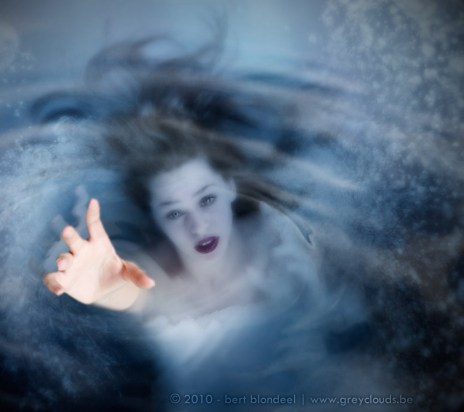
The other night I had a disturbing dream where I saw a child being abducted and carried away. My heart went out and I desperately tried to recapture or save her.
On the next night I was carrying two books, one was a large book with beautiful illustrations and embellishments and the other with the word “Hope” emblazoned on the dust jacket. As I carried them across a deck overlooking the water I dropped them and they sank to the bottom, I quickly reached for them and saved them from a watery demise.
The dreams followed a two day run of depression and negative self-talk.
While writing the dreams in my journal the fog of meaning started to clear and I jotted down the beginnings of my interpretation.
“Innocence: The phenomenon of seeing without judgment, notions, bias, or to see purely i.e. to take something in without changing it or “adulterating” it. I have lost this reality and want ever so badly to recapture it, to make it my own again. It made sense to me a sense that adulthood has never made.
The world of imagination (a child’s world) captures my heart and holds it with far more interest than anything the material world of the adult has to offer. The imaginal feeds, the material does not. The material leaves me empty no matter how much I have, unfulfilled, and un-nurtured.
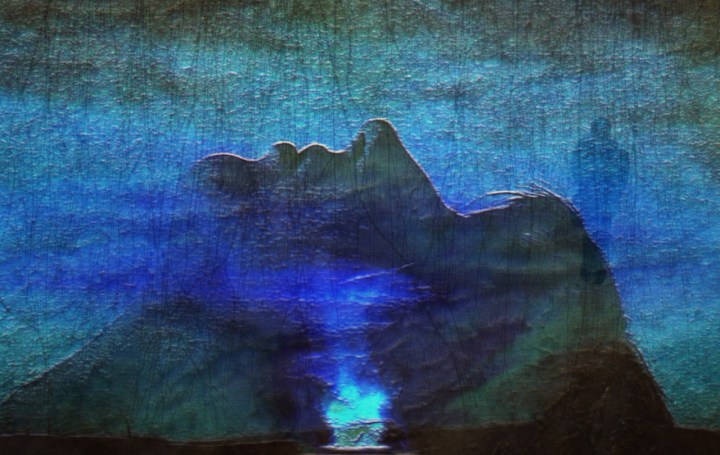
This is also the message of the “Blue Fresco” dream a number of years ago where I first met a Spirit Guide, Sophia, who invited me to leave behind the adult world that is so very childish in its pursuits and follow a path of my own. Basically she gently admonished me to stop trying to get what will nurture from the material world. It cannot fulfill or nourish what is truly important in and to me.
I have been acting as though I am my thoughts rather than being that which thinks.
The dream where I drop the books into the water may also be an encouragement to stop looking to the material world for my satisfaction, soul, or sense of being.
The answer i.e. “Hope” for me is only to be found in the intuitive, imaginal, mystical, and spiritual realm. As with the “Blue Fresco” dream these dreams remind me to leave behind my childish search for acknowledgment in the material world because it’s not there.
The “Retrieval” aspect of both dreams seems to be speaking to a transformation of thinking metaphor suggesting a need to transform my current negative inner narrative in order to save me. I need to reach into the primal waters and pull myself out. The drowning book in the second dream may also represent the rigid intellect being drowned but allowing the creative to be saved. The inner self desires to be free. It may be my only “Hope”. By continually looking for rigid intellectual “consensus reality” I will always be drowning and stifled. I need to reach into the deep dark waters and save myself.”
Sitting outside one morning watching the sun rise above the hills of the Colonial Valley and sipping from a cup of coffee cradled between my hands and warming the air around and within I looked down into the cup of dark liquid and this came to mind…
__________________
A shadowy and bitter brew somehow satisfying some hidden emotional need.
In its liquid darkness the Daimon hid and waited to spring forward on my not fully awake soul and wrestle me to the ground demanding that I pay attention. With the next sip I paused to look inward and again found the other self.
Reflections from the dark mirror within the cup transformed into intuitive murmurs and visions from the unconscious like Scrying mirror images from the imaginal.
Suddenly, as these things always seem to come, the quiet turned to tension and I knew that it was time again to get up and confront the Daimon.

 Sitting outside one morning watching the sun rise above the hills of the Colonial Valley and sipping from a cup of coffee cradled between my hands and warming the air around and within I looked down into the cup of dark liquid and this came to mind…
 The Dark Knight of the Soul